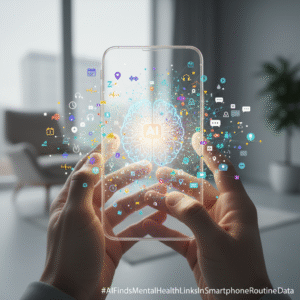
# AI finds mental health links in smartphone routine data
AI finds mental health links in smartphone routine data
Understanding the real-world behavioral manifestations of mental health symptoms like depression and anxiety has historically been challenging, often relying on self-reported questionnaires and interviews prone to recall bias [1], [2], [6]. However, multimodal sensor data collected from personal smartphones and connected devices now offers a robust opportunity to objectively capture granular, long-term behavioral patterns and their association with mental health outcomes [7], [8].
Summary of the Trend
A growing trend in mental health research involves leveraging multimodal sensor data from personal smartphones and connected devices to objectively study long-term human behaviors, moving beyond the limitations of traditional self-report methods [1] [7] [8]. Unlike questionnaires and interviews, which are susceptible to recall bias and rely on participant memory, digital sensing offers granular, third-party observational data for understanding real-world behavioral manifestations of conditions like anxiety and depression [1] [2] [3] [4] [5] [6].
This approach focuses on identifying and analyzing individual-specific routine patterns, defined as regularly performed sequences of behaviors, by recognizing the inherent structural and repetitive properties of long-term behavioral data [1] [9]. Researchers are exploring how variability in these daily routines across different life aspects can serve as a personalized digital marker, directly linking observed behaviors to self-reported affective states such as anxiety and depression symptoms [1]. Non-negative matrix factorisation (NMF) is employed to decompose mobile sensing data into these routines and their weekly variability, with Generalized Linear Models (GLMs) then associating this variability with mental health states [1].
Furthermore, large language models (LLMs) like GPT-4o are being integrated to translate complex modeling results into accessible language, enhancing individual engagement with their own routine phenotypes for self-regulation insights [1]. Initial findings indicate that this method can uncover personalized behavioral patterns and inform group-based interventions by identifying individuals with similar routine characteristics who might benefit from shared treatment strategies [1]. This represents a significant shift towards data-driven, personalized understanding and intervention for mental health.
Critical Analysis
The extensive collection of “multimodal sensor data captured on personal smartphones and other connected devices” [1] for long-term behavioral analysis, while offering granular insights, inherently raises significant privacy and data security concerns. The deeply personal nature of this data, detailing an individual’s daily life and routine patterns, necessitates robust ethical frameworks and transparent data governance. Without explicit details on how these privacy risks are mitigated, there is a potential for misuse or breaches of sensitive information, which could erode user trust and engagement in such digital health applications.
Furthermore, the integration of large language models (LLMs) like GPT-4o to “translate the modelling results into more accessible language” for “self-regulation insights” [1] presents both opportunities and challenges. While aiming to empower individuals, LLMs can be susceptible to generating plausible but inaccurate or biased interpretations, particularly in complex and sensitive domains such as mental health. This potential for misinformation could lead individuals to draw incorrect conclusions about their “mood-related drivers” [1], potentially impacting their well-being. Additionally, the approach primarily focuses on *associating* routine variability with anxiety or depression states [1], which establishes correlation rather than direct causation, limiting the immediate prescriptive power without further interventional studies.
Finally, while the method identifies “individual-specific routines” and “routine phenotypes” [1], the acknowledgment of “significant between-group differences in mental health measures” at a population level [1] suggests potential limitations in generalizability. Personalized insights are valuable, but the unique nature of each individual’s routine and mental health experience means that broadly applied interventions based on these patterns might not be universally effective or require extensive, resource-intensive customization. The definition of a “routine” as a regularly performed sequence of behaviors [1] might also oversimplify the often irregular and complex daily lives of individuals, especially those grappling with severe mental health conditions.
Implication for Practice or Policy
The integration of multimodal smartphone sensor data with machine learning offers a powerful avenue for advancing mental health practice and policy [1]. Practitioners can utilize personalized digital markers of routine variability to provide individuals with actionable insights for self-regulation, thereby empowering them to understand and manage their anxiety and depression symptoms more effectively [1]. Furthermore, this approach can inform the development of targeted group-based interventions by identifying individuals with similar routine patterns, optimizing resource allocation and intervention efficacy [1]. From a policy perspective, the rich, granular nature of this data necessitates the development of clear ethical guidelines and privacy regulations to ensure responsible implementation, balancing therapeutic potential with individual data protection in digital mental health initiatives [1].
Closing Reflection
This innovative approach, combining mobile sensing and machine learning with large language models, offers a promising path for creating personalized digital markers of mental well-being. Future research should explore the integration of these insights into real-time, adaptive interventions to support self-regulation and inform targeted clinical strategies.
Signature
Dr Omar Tujjar – MD, MA, MPH, PGDip, EDAIC, EDRA Consultant in Anaesthesia, Intensive Care, and Pain Medicine National Orthopaedic Hospital Cappagh Dublin, Ireland (++353) 085 1781872