# Digital tools forecast cancer toxicity, reveal personalized mental health patterns
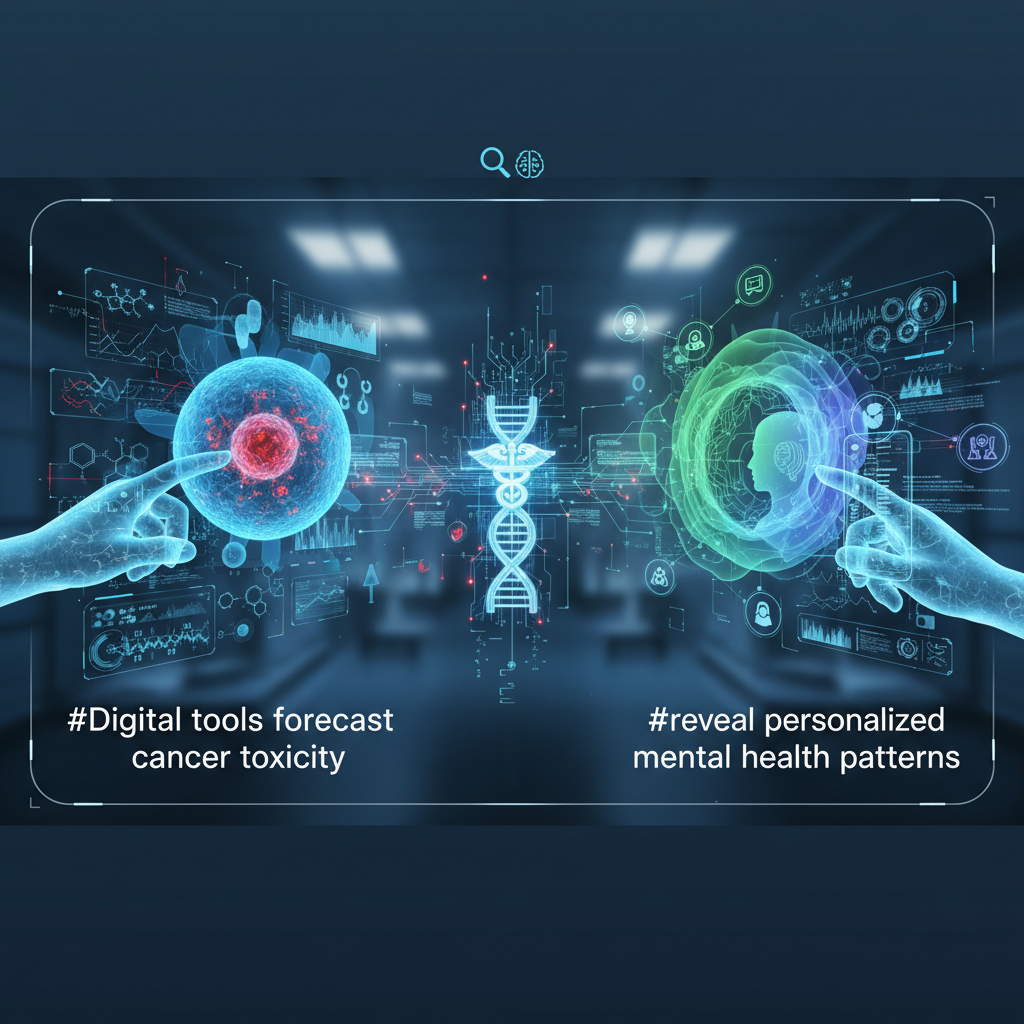
Digital tools forecast cancer toxicity, reveal personalized mental health patterns
The field of medicine is increasingly leveraging advanced digital technologies to enhance patient care and understanding of health conditions [1] [2]. These innovations range from developing virtual representations for predicting treatment toxicity in severe diseases to utilizing smartphone data and AI for personalized mental health insights [1] [2].
Summary of the Trend
Digital technologies are increasingly being integrated into medical practice to address complex patient challenges, moving towards more personalized and predictive healthcare [1] [2]. This trend involves leveraging advanced computational models and real-world data collection to gain deeper insights into disease progression, treatment responses, and patient well-being [1] [2].
One significant development is the creation of medical digital twins, which are virtual representations designed to forecast disease progression and simulate potential treatments [1]. For instance, mechanistic models are being developed to predict therapeutic toxicity, such as neutropenia, in acute myeloid leukemia (AML) patients receiving venetoclax and azacitidine treatment, a critical challenge given the life-threatening nature of these side effects [1].
Concurrently, multimodal smartphone sensor data are being utilized to provide rich insights into real-world behavioral patterns linked to anxiety and depression symptoms [2]. This approach identifies variability in daily routines as a personalized digital marker, moving beyond traditional retrospective self-report methods. Machine learning techniques and large language models (LLMs) are then employed to analyze these patterns and translate complex findings into accessible language, enhancing individual engagement and self-regulation insights [2].
Critical Analysis
While the development of mechanistic models for predicting therapeutic toxicity in acute myeloid leukemia (AML) patients holds promise, several critical limitations and considerations warrant attention. The study explicitly acknowledges that “patient-specific accuracy was highly variable” [1] for the best-fitting model. Although efforts were made to identify patient subsets and features predictive of model fit, this inherent variability poses a significant challenge for a tool intended for precise clinical decision-making, particularly in a life-threatening context where consistent reliability is paramount. The need for the model to be “further validated in a larger clinical setting” [1] also highlights that its current performance and generalizability beyond the study cohort are not yet established for widespread clinical application.
The complexity of acute myeloid leukemia itself presents a substantial hurdle for predictive modeling. AML is characterized by “high molecular heterogeneity and varied responses to treatment” [1], making it difficult for any single model to capture the full spectrum of patient-specific biological nuances. Furthermore, while the current work focuses on neutropenia, which is a major concern in AML treatment, therapeutic toxicity extends to other serious adverse events like thrombocytopenia [1]. A model exclusively targeting neutropenia, though valuable, does not provide a comprehensive assessment of all treatment-related toxicities that can necessitate dose modifications or treatment discontinuation, potentially limiting its holistic utility for clinicians.
Finally, the suggestion that the model “may support a digital twin for decision making” [1] indicates a future potential rather than an immediate, fully integrated solution. Translating such a predictive model into a functional medical digital twin for routine clinical practice involves substantial practical and ethical considerations. This includes rigorous real-world validation across diverse patient populations, ensuring seamless integration into complex clinical workflows, and addressing the regulatory challenges and medico-legal implications of relying on AI-driven predictions for adjusting critical cancer therapies. The leap from a promising research model to an actionable, trusted clinical decision-support tool is significant and requires careful navigation beyond predictive accuracy alone.
Implication for Practice or Policy
Medical practices and policy should prioritize the integration of personalized digital tools and predictive models to enhance patient management and optimize treatment outcomes across various medical domains. For conditions such as acute myeloid leukemia, developing and deploying medical digital twins capable of forecasting therapeutic toxicity, like neutropenia, would enable clinicians to implement enhanced disease monitoring and dynamically adjust treatment schedules with venetoclax and azacitidine, thereby mitigating severe adverse events and improving patient survival [1]. Furthermore, policies must encourage continuous data collection and model updating to maintain and improve the real-time accuracy and clinical utility of these predictive tools [1]. In parallel, leveraging personalized behavioral pattern analysis, potentially through advanced models, can inform targeted group-based interventions for mental health, guiding clinicians in selecting optimal shared treatment strategies and fostering patient self-understanding [2].
Closing Reflection
The continued advancement of personalized digital tools, including medical digital twins and advanced AI models, holds significant promise for transforming patient care. These innovations are poised to enable more precise disease management and tailored interventions across diverse medical conditions.
Signature
Dr Omar Tujjar – MD, MA, MPH, PGDip, EDAIC, EDRA Consultant in Anaesthesia, Intensive Care, and Pain Medicine National Orthopaedic Hospital Cappagh Dublin, Ireland (++353) 085 1781872